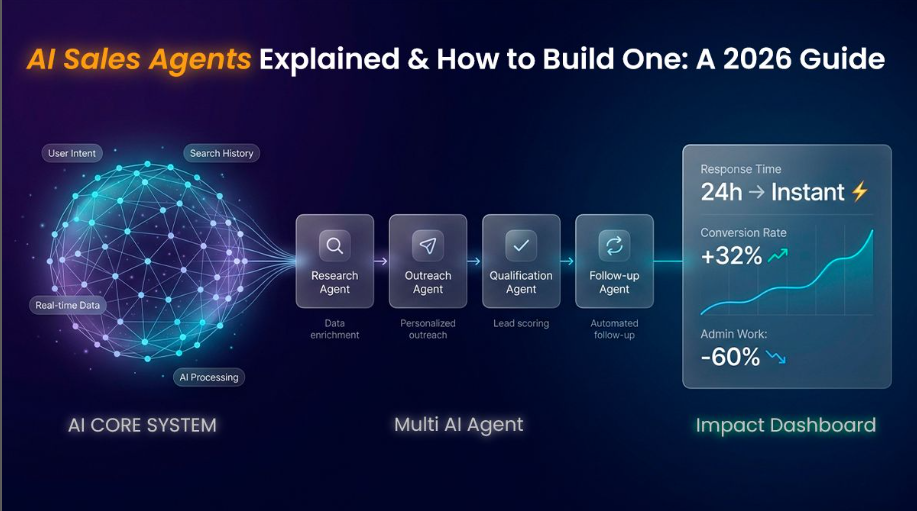
Short answer: An AI sales agent is software that handles parts of the selling process, such as responding to leads, qualifying them, booking meetings, updating the CRM and following up, with little human intervention. To build one, pick a single use case, connect your data sources, define guardrails and handoffs, enable actions, test on real scenarios, roll out gradually and keep measuring.
Table of Contents
There is a lot that goes into a B2B deal, and every step matters. If a prospect hits friction at any point in the buying journey, the chance they walk away rises.
The obvious problem is that most B2B sellers don’t have time to deliver the personalized experience buyers expect. Sales reps are buried in heavy, tedious tasks, leaving little time to build relationships and close deals. That is why more organizations are turning to AI sales agents to bridge the gap. Below we cover what they are, how they work and how to build one.
What Is an AI Sales Agent?
An AI sales agent is a tool that uses AI, typically large language models (LLMs), to perform or assist with selling tasks. It needs minimal human intervention and is used to save time and improve customer experience. Agents can help with:
- Lead qualification
- Scheduling meetings
- Communicating with leads and answering their questions on the spot
- Recording data accurately in sales applications
- Evaluating sales calls and suggesting follow-up actions
Unlike older automation that follows fixed rules, AI-driven sales assistants can read situations from emails, chats and CRM interactions, work out customer intent and sentiment, and take action across multiple applications. For how this differs from a simple chat tool, see AI agents vs. chatbots for growing businesses.
Types of AI Sales Agents
Agents differ depending on where in the sales funnel they operate.
| Type | What it does | Risk level | Best for |
|---|---|---|---|
| Assistive | Supports reps with research, account summaries, CRM updates, call notes and email drafts that a person reviews | Low | Smaller teams and first deployments |
| Autonomous | Completes the process without a rep: talks to prospects and books meetings on its own | Higher | High-volume, well-defined processes with strong guardrails |
| Specialized (multi-agent) | Several agents, each focused on a task such as research, outreach or qualification, working in sequence | Medium | Teams with mature processes; an increasingly popular approach in 2026 |
Key Benefits of AI Sales Agents
Instant Lead Response
Responding in real time increases conversion rates and makes sure no lead is missed. See why businesses lose leads for why this matters.
Faster Qualification
Tasks that used to take days can be done in hours through real-time data analysis. Our guide to how AI improves lead qualification goes deeper.
Reduced Admin Work
Reps spend more time building relationships and closing deals, and less time updating the CRM.
Scalable Personalization
Agents can tailor their approach to each prospect without losing relevance as volume grows.
|
AI Sales Agents Turn slow follow-up into a faster, steadier pipelineClarityTech Labs builds AI sales agents around your CRM and your sales process, with guardrails and clear handoffs to your team. |
Real-World Use Cases of AI Sales Agents
AI sales agents can be used throughout the funnel:
- Inbound lead qualification: qualify leads immediately when they arrive
- Outbound prospecting: qualify and prioritize leads for outbound campaigns
- Meeting scheduling: remove the email ping-pong
- Follow-up: re-engage stalled deals automatically
- Sales operations: keep data accurate and workflows compliant
Vertical examples: real estate lead automation and conversational AI in sales and support.
How to Build an AI Sales Agent (Step-by-Step)
At ClarityTechLabs there is one mistake we see repeatedly: teams try to automate everything at once. It rarely works, and the winners build up from a narrow start. This is how we build AI sales agents.
Step 1: Choose a Clear Use Case
Narrow the scope first. “Respond to new inbound leads within one minute” is a much better starting point than “automate sales.”
Step 2: Connect Your Data Sources
The agent needs accurate, real-time data. It requires access to your CRM, marketing tools and communication channels, so integration quality decides how useful it will be.
Step 3: Define Instructions and Guardrails
This step often decides success or failure. Define:
- What the agent should do
- What it should not do
- When the conversation must be passed to a human
Guardrails keep the agent within your guidelines, messaging standards and compliance rules.
Step 4: Enable Actions and Integrations
A true AI sales agent doesn’t just react; it acts. It should be able to:
- Send targeted emails
- Update the CRM automatically
- Assign tasks to your team
- Schedule meetings without back-and-forth
Step 5: Test With Real Scenarios
Before deployment, test:
- Edge cases from real-life situations
- Wrong or incomplete inputs
- Tone, accuracy and effectiveness of communication
The principle is simple: reliable first, scalable later.
Step 6: Deploy Gradually
Don’t roll out everywhere at once. Start with one process or department, observe results carefully, then scale based on success. This reduces risk and builds early confidence.
Step 7: Monitor and Optimize
Scaling is only half the equation. Keep tracking performance, and use the data to improve the agent.
Metrics to Track
| Metric | Why it matters |
|---|---|
| Average response time | The core speed advantage of the agent |
| Lead-to-meeting rate | Shows whether faster response becomes real conversations |
| Conversion rate by source | Ties the agent to revenue |
| Time saved per rep | Measures the admin work removed |
| Handoff rate and reasons | Shows where the agent needs improvement |
| Opt-out and complaint rate | An early warning that outreach is too aggressive |
Compliance and Trust
An agent that contacts prospects has to follow the rules for how you contact them. In the US, automated calls and texts fall under the TCPA, which requires proper consent, and commercial email must follow CAN-SPAM. Be transparent when prospects are speaking to AI, and keep opt-out handling working from day one. This is general information, not legal advice; confirm requirements with your counsel.
Best Practices for AI Sales Agents
- Keep people in the loop for key decisions
- Avoid over-automation at the start so the team stays in control as the system grows
- Keep data clean and organized across systems
- Define revenue targets for each agent
- Keep improving through monitoring
Automation without strategy is what fails most often.
The Future of AI Sales Agents
At ClarityTechLabs we favor a collaborative approach: instead of one generalist agent that does everything, we build specialists for research, outreach and qualification. When they work in a cohesive sequence, the whole thing behaves like a well-run sales team.
Sales teams that get good results with AI aren’t the ones rushing in headfirst. They start small, find practical applications, set guardrails and scale when it makes sense. The payoff is less workload and more revenue through the pipeline. For the wider view, see AI agents for business in 2026, or book a demo call.
FAQ
What is an AI sales agent?
An AI sales agent is software that uses AI to handle parts of the sales process, such as responding to leads, qualifying them, booking meetings, updating the CRM and following up, with minimal human intervention.
How do you build an AI sales agent?
Choose one clear use case, connect your data sources, define instructions and guardrails including human handoff, enable actions and integrations, test on real scenarios, deploy gradually, then monitor and optimize.
What is the difference between assistive and autonomous AI sales agents?
Assistive agents support reps with research, notes and drafts that a person reviews. Autonomous agents complete tasks such as talking to prospects and booking meetings on their own, which carries more risk and needs stronger guardrails.
Will AI sales agents replace sales reps?
No. They handle repetitive work such as response, qualification and admin so reps can spend time on relationships and closing deals.
Is it legal to use AI to contact sales leads?
It can be, if you follow the rules. In the US, that means proper consent under the TCPA for automated calls and texts, CAN-SPAM compliance for email, working opt-outs and appropriate disclosure. Confirm details with your counsel.